


Step 1. Adaptation
If you have a finished design, we adapt it for production and installation, preserving every detail.
Step 2. Define your vision
Capture a clear picture of the client’s ideas before moving to design and rendering.
Step 3. Plan specifications
Outline measurements, production methods, and finalize materials, components, and finishes.
Step 4. Production and assistance with logistics

Step 1. Define your vision
The aim of this step is to capture a precise picture of the client’s vision before proceeding to technical design and visual rendering.
Step 2. Plan specifications
During this phase, we define the specifications, production methods, and measurements, while finalizing the look by selecting materials, elements, and finishes.
Step 4. Production and assistance with logistics

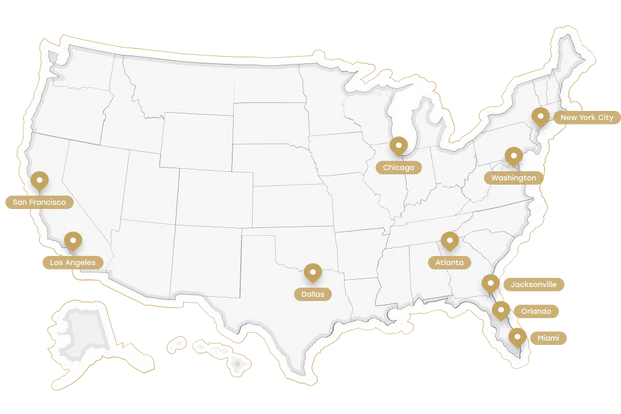
We proudly serve clients across the United States,
including major cities such as
· Jacksonville · Orlando · Miami · Atlanta · Dallas · Los Angeles · New York City · Chicago · Washington · San Francisco ·


We needed to restore an antique fence on the estate grounds. It required intricate molding. Royal Foam manufactured all the elements from high-density PU foam, replicating the historic pattern. The restorers were impressed by the precision and strength of the material.
Frank Lombardi
We just called to ask about options… and ended up ordering a whole fence! The consultant explained everything about the materials so thoroughly (we went with EPS since our perimeter is long) that all our doubts disappeared. Now the neighbors are asking who installed such cool "stone" panels.
Hank & Betty
I wanted a modern fence with geometric inserts. Sent a sketch to Royal Foam—they said "no problem" and made it from PU foam! The details are sharp, the installers praised how easily everything fit together. Got exactly the design I envisioned.
Jack Davis

In today’s architectural landscape, exterior elements are no longer just an afterthought. A stucco fence is not simply a boundary anymore. It has evolved into a design statement, a brand touchpoint for commercial spaces, and a critical component in shaping first impressions. When executed correctly, it elevates curb appeal, reinforces the architectural concept, and adds long-term value to a property.
Over the past decade, we have seen a significant rise in demand for architectural boundary solutions across the US. Design teams are no longer satisfied with standard wood or metal fences that look like every other project on the block. They want architectural boundaries, architectural wall panels, and fully integrated architectural boundaries and gates that align with the aesthetic language of a building. They want consistency, precision, and a level of customization that typical off-the-shelf products cannot deliver. That is precisely where stucco fencing has taken center stage.
Whether you are designing a coastal boutique hotel in Naples, a modern private residence in Miami, or a commercial development in Atlanta - a well-executed stucco boundary sets the tone before anyone even reaches the entry door. A modern stucco fence wall can frame the architecture like a gallery frame enhances artwork. And a white stucco fence can instantly create that effortless Mediterranean-meets-Palm-Beach visual serenity.
A stucco fence is an exterior fence finished with a stucco coating to achieve a smooth, textured, or architectural surface. Traditionally, stucco was applied over heavy masonry or concrete block structures. It looked impressive but came with long installation timelines, weather dependency, and costly labor - especially in states with high labor rates like Florida, California, and New York.
Today, with the evolution of stucco fence panels, manufacturers can create lightweight, pre-engineered systems with the same aesthetic as masonry but with faster installation and fewer risks. You get the solid wall effect of a stucco wall fence without the drawbacks of traditional construction.
And here is the real reason the market shifted:
Stucco wall fences satisfy three critical needs at once:
Stucco fence ideas now extend far beyond the classic beige wall. Clients request everything from ultra-modern monolithic finishes to Venetian plaster-inspired textures, shadow-gap details, wood accents, and integrated lighting.
Stucco has traveled a long way from ancient architecture. Historically, it adorned European villas, Spanish-style estates, and Mediterranean palaces. However, if you remember typical stucco fences of the 80s and 90s in the US - especially in Florida - you will recall bulky, heavy, moisture-prone structures that cracked, stained, and required constant patching.
When we started in architectural fabrication 25 years ago, most clients asked for classical ornamentation: columns, balusters, scrolls, and heavy trim. Today, everything has shifted. Clean lines, minimalist silhouettes, and modern stucco fence concepts dominate the design scene. We have observed this change across projects - from Coral Gables to Jacksonville to Savannah - watching preferences evolve in real time.
A timeless choice. Solid, structured, and elegant. Ideal for residential communities, upscale neighborhoods, and estates. Works well with Spanish, Mediterranean, Tuscan, and transitional designs.
Lower-profile fencing that defines the entrance, courtyard, or storefront. Commonly used in:
These solutions are often chosen by restaurants seeking both curb appeal and a premium brand experience.
Warmth meets refinement. Ideal for creating a sense of hospitality and residential comfort. Works especially well for wellness resorts, spas, and multifamily developments.
There has been a noticeable increase in architectural boundary designs that blend textures, colors, and materials in unexpected ways. Today, a boundary is no longer just a boundary. It is part of the brand, the first impression, and the overall visual narrative.
Across hundreds of projects, one consistent observation stands out: an exterior wall system can completely shift the perception of a property. It sets the stage before architecture, landscaping, or signage begin to communicate.
Foam boundaries deliver the strongest return on design and investment in the following contexts:
One example involves a boutique hotel where the owner envisioned an exterior wall system with a Mediterranean feel. We created a warm white foam boundary with integrated soft LED lighting. The result resembled a postcard brought to life. The owner later used images of this exterior wall system as the primary visual on rental platforms and promotional listings. Over time, guests began recognizing the hotel specifically because of this feature, and bookings increased significantly due to stronger visual identity and brand recognition.
This illustrates how an exterior wall system, initially perceived as a perimeter element, can directly influence business performance.
From a practical standpoint, foam boundaries represent a significant advancement. Compared to heavy, labor-intensive stone or concrete systems, they offer comparable aesthetics with reduced weight and simplified installation.
The key advantages of foam include not only its lightweight nature but also its flexibility in custom design. It enables complex geometries and creative solutions while maintaining durability. Additionally, these systems require minimal maintenance, do not need ongoing treatment, and retain their appearance for 5-10 years or more.
This is not only about aesthetics; it is also about effective risk management.
The overall cost of a stucco fence includes not only materials but also labor, installation time, and related factors:
In the US market, where labor costs are high and delays can damage a company’s reputation, choosing cheaper materials can result in higher total costs. Cases have been observed where saving 8-10 percent on materials led to losses of 25-35 percent due to rework, extended labor, and missed deadlines.
Foam-based stucco fence systems reduce uncertainty, which is often the most expensive factor in construction projects.
With over 25 years of experience in architectural fabrication, the focus is not on selling a product but on delivering a complete solution that performs technically, aesthetically, and financially.
Key advantages include:
Clients receive not just a supplier but a partner who understands deadlines, budgets, and the importance of consistent results.
One project in Aventura involved designing custom architectural boundaries for a residential development. The client later confirmed that timely delivery allowed the project to be presented fully completed. In this context, execution reliability proved more valuable than material cost savings.
A stucco fence is no longer just a boundary. It is an architectural element that reinforces the design and identity of a property. A well-designed foam fence becomes an integrated extension of the architecture, enhancing both perception and value.
Material selection, design decisions, and the choice of manufacturing partner should reflect the understanding that a fence is part of the architectural system, not a secondary component.
For projects requiring efficient installation, cost control, strong design impact, and reliable results, a tailored solution can be developed based on drawings, reference images, or initial concepts.
Submit your request to begin project evaluation and development.