


Window surrounds – Inspiration for exterior decisions
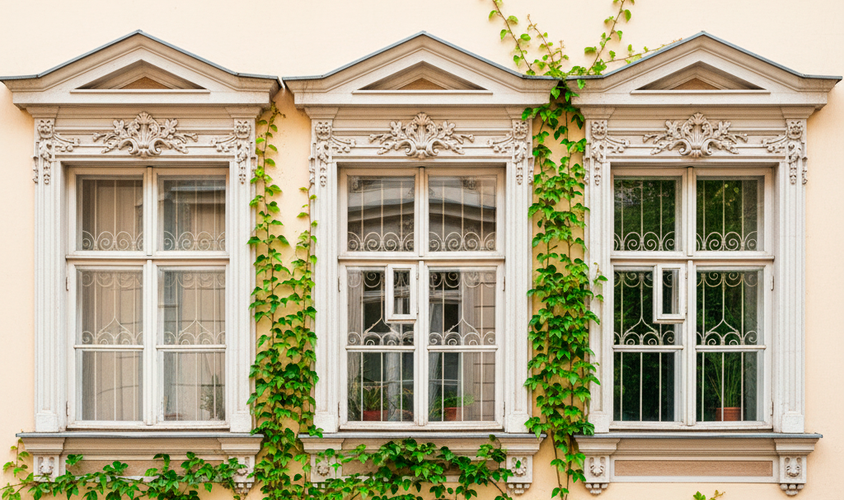
Window surrounds help to:
• add dimensional character and break the flatness of a wall
• unify the design language across a building
• emphasize the architectural style, from traditional to ultra-modern
• elevate the perceived value of residential or commercial properties
• turn a plain façade into a signature visual statement
Simply put, exterior window surrounds turn a building from “constructed” into “designed.”
They serve a much bigger purpose than simple decoration and create beautiful shadow play and, most importantly, give the facade a sense of rhythm while balancing its proportions. They complement the architecture and style. One of their strongest advantages is their versatility. They can be used on private residences and small boutique hotels, cafés and restaurants, multifamily buildings and clubhouses, commercial properties also. They elevate the look of any space and bring a refined, finished feel wherever they are applied.

A brief, yet fascinating journey of window surrounds through time
Looking back helps us understand why exterior window surrounds still hold so much design power today. In ancient architecture, stone surrounds were structural, reinforcing openings. During the Renaissance and Baroque periods, windows became an artistic focal point. Surrounds grew richer, with pilasters, ornate keystones, and pediments that made every window feel like a framed portrait.
In the U.S., evolution took a different route. Colonial architecture favored modest, well-proportioned, geometric trims. The Victorian era pushed the opposite direction: decorative, expressive, sometimes exuberant. And when we first started in this industry 25 years ago, the early 2000s were full of bold, heavy decorative window surrounds with classical curves and statement keystones. Houses wanted to “speak grand.”
Today’s trend is different. Minimalism reshaped façades. Cleaner lines, intentional simplicity, curated textures. Architecture became lighter, more breathable. But what’s interesting is this: even minimalism didn’t eliminate window surrounds. It made them more important. With clean walls, every detail matters. One well-balanced surround can anchor an entire façade.
And ironically, the more minimal the design becomes, the more any mistake stands out — which is why clients choose custom-made surrounds with precision, not off-the-shelf improvisations.
Types of exterior window surrounds: small detail, big impact
We focus on six design styles that most dramatically influence the building’s character. Same material — architectural foam — yet drastically different results. Because the magic lies in proportions, depth, profile, and texture.
Modern Minimalist Window Surrounds
Concise, clean-lined surrounds with no decorative detailing, designed for contemporary architecture. Commonly used for modern residential and commercial projects. For a project in Sarasota, FL, we manufactured 22 surrounds with a depth of 1.6 inches, supported by a 3D shadow-study model to ensure accurate sun-angle performance.
Classic Trim Window Surrounds
This solution is all about respect for architecture — the kind of refined beauty that doesn’t shout, but speaks softly and confidently. Soft lines, balanced proportions, and the right shadow depth make the façade look harmonious, “polished with good manners.” This style works especially well for Colonial Revival, Mediterranean, and Traditional American homes where understated elegance is valued.
One project in St. Augustine, Florida, stays close to our hearts. The homeowner — a literature professor — welcomed us with a specific request: “I want my house to look well-mannered.” We designed Classic Trim surrounds, 2.75 inches thick, and selected a creamy tone that felt like a natural extension of the historical stucco, rather than a new element “glued on.” Installation took just two days, but the effect was like a subtle facelift: nothing flashy, yet undeniably noticeable. The homeowner later said, “Now my house has a warm, friendly smile.” And she was right — the house truly came to life.
Decorative Surrounds with Keystone or Pediment
If Classic is elegance and Minimalism is quiet luxury, then decorative window surrounds and window trims are architecture’s statement jewelry for homes aesthetic. Keystone or pediment turns a simple window into a focal point. Boutique hotels, restaurants, and clubhouses love this style.
We once had an especially romantic and truly memorable project. A small bistro in Savannah, Georgia wanted to elevate its exterior and bring in that authentic French, Parisian charm. The owners didn’t want anything cliché or cheap-looking — nothing that would make the place feel tacky or overdone.
We designed elegant surrounds with refined petite pediments and classic keystone accents, using a 3.25-inch profile and choosing an antique-style finish that resembled aged limestone. The timeline was a real challenge — the bistro was set to open in less than a month. We created the 3D mockup overnight, finalized all the design details with the client the very next day, and launched production with night shifts to keep everything on track.
Everything was delivered and installed right on schedule. The delighted owner later sent us photos and proudly said, “Now I have my own little Paris. I’ll be back for the Eiffel Tower next!”
Arched Window Surrounds
Soft, romantic, and technically demanding for homes aesthetic. Arched elements must be precise — any misalignment becomes painfully visible. But when done well, they give a façade a boutique European charm.
In Tallahassee, FL, a homeowner wanted three arched windows above the entry that looked “like one sculpted piece.” “No visible seams,” the architect insisted. We manufactured each surround as a single 9-ft element to avoid joints. A fine sand-finish coating made them appear like cast stone. Later the client told us, “Walking up to the house feels like arriving at a villa on the Amalfi Coast.” That feeling — worth every detail.
Modern Faux Stone Window Surrounds
This fast-growing trend is all about luxury without the “stone hassle.” Modern stone surrounds made from foam with a stone-effect coating look like real limestone, travertine, or sandstone — but weigh a fraction and install quickly. No structural reinforcement, no cranes, no headaches.
We once had a particularly memorable project in Florida. The client wanted to recreate an authentic “Italy by the water” feeling. We prepared several design options for the architectural elements, and eventually everyone gravitated toward one concept — light travertine-style surrounds with a subtle coral touch. The profile was 2.9 inches with a stone-textured finish. Later, neighbors kept asking the homeowner which quarry the “stone” came from, which, of course, became a point of pride for us. That’s the beauty of foam: the elements always achieve a premium look, while remaining unique and full of character.
Custom-Shaped Exterior Window Surrounds
These are solutions chosen by architects who refuse ordinary, copy-paste designs and visual appeal of architecture. Angled windows, corner glass, trapezoids, bay windows, artistic shapes — any unconventional construction gains personality and architectural presence when paired with foam elements.
We once worked with an architect in Valdosta, Georgia, who sent us a sketch of a window with a very unconventional elongated hexagon shape. It was a bold idea that could have easily gone wrong. But we developed a 3D model with Art Deco floral details. We also supplied full drawings and technical documentation to ensure a smooth, clean installation process.
We were genuinely thrilled that our architectural solution eventually became the signature element of the façade — the detail that gave the home its luxurious finished look and a style all its own.

Why foam window surrounds and window trims outperform other materials
We can say (after decades watching materials age and impact budgets) that architectural foam delivers the best blend of design freedom, durability, and project efficiency.
Extremely lightweight — no structural stress
Even large external window surrounds don’t require structural reinforcement or heavy machinery. This cuts installation time, labor cost, and risk of on-site errors.
A build in Palm Coast, FL originally planned to be cast stone. Weight calculations doubled the budget due to wall reinforcement. Foam achieved the same upscale look, shaved three days off the schedule, and kept the concept intact. “You didn’t just save our budget. You saved our design,” the GC told us.
Unlimited design flexibility
Clean lines, complex curves, deep shadows, ornate pediments — foam delivers it all. It allows precision cutting and consistent replication for multiple units. Custom isn’t expensive and difficult here — it’s accessible.
In Macon, GA, townhomes had slightly inconsistent window sizes due to an older plan. We manufactured each surround to real-life onsite dimensions, not only drawings. The crew installed them without any trimming.
When the Finish Works for Your Business, Not Against It
One of the biggest advantages of architectural foam elements is the protective finish that gives you the look and feel of high-end natural materials.
We once saw this play out beautifully for a small boutique hotel in Clearwater Beach. The owners dreamed of that “five-star Mediterranean seaside resort” aesthetic. Our limestone-style transformed the faсade. The finish stood up to salty air, humidity, and coastal winds, but the best part was that it helped sell the feeling of the place before guests even stepped inside.
Straight to the Point
The protective coating resists UV, moisture, salt air, mold, and temperature swings.
Installation Without the Circus and Drama
Installing foam architectural elements is significantly easier than dealing with stone or concrete. No cranes. No oversized crews. No week-long “adjust and pray” process. Everything goes up faster, cleaner, and with fewer moving parts. If installing stone feels like mounting a mini construction expedition, foam surrounds feel like a well-engineered system created to make life easier for everyone on-site.
You save time, labor, and budget — and you dramatically reduce the margin for error. Maintenance is just as painless: a quick rinse now and then to freshen the façade, almost like wiping fingerprints off your sunglasses — fast, simple, and instantly cleaner.
When the Texture Is So Real, People Need to Touch It
Here’s where the magic really kicks in — realism. The textures look so authentic that even pros get fooled. Faux stone has depth, pores, and shadow play. Faux wood shows grain and those tiny fiber lines that make your hand want to knock on it. And the faux concrete finish… let’s just say if minimalism had a smile, this would be it — calm, confident, and architectural.
In Sarasota, a boutique owner initially insisted on real stone, but agreed to test one sample piece. We installed a single demo surround. The next day, he called us laughing: “Three customers asked how I got permission to drill into natural stone in a historic district!” Then he said, “If people believe it’s stone, then it’s stone. End of story.”
In Boca Raton, a designer ran a little experiment and didn’t tell the homeowner that the “travertine” was foam. For four months, she received nonstop compliments about the “stunning Italian stone.” When she finally learned the truth, she gasped, laughed, and said, “If I didn’t notice the difference in my own home — you’re basically architectural magicians.” Moments like that are why our team loves what we do: a bit of illusion, a lot of craft, and a façade that looks like a million bucks.
Why working with us pays off
We’re not here to sell a product. We deliver a predictable result — the one your design, timeline, and reputation can rely on.
-
Made in the USA.
-
25 years of architectural know-how
-
Custom, not just catalog design.
Yes, most of our work is custom. Pinterest inspiration and a pencil drawing — we’ll engineer and produce it.
-
Support all the way through
From concept and 3D mockups to tech documentation and installation guidelines. We think through joints, mounting paths, and segment sizes so crews don’t waste time onsite. When possible, we pre-assemble segments before shipping.
-
Quality and precision guarantee
Measurements match drawings. Colors match wall finishes. Profiles align. Our goal: zero onsite “cut and adjust.”
Architecture is the final emotional layer of a project. The moment when form meets feeling. And when we see how a facade comes to life — that spark of pride hasn’t changed since day one of our journey. If you want your building to have depth, personality, and a signature look, share your plans, sketches, or even a napkin doodle — we’ll turn it into a solution that feels tailored, smart, and worth it.
Request a fast quote!
Contact Us
Catalog